

New book chapter published!
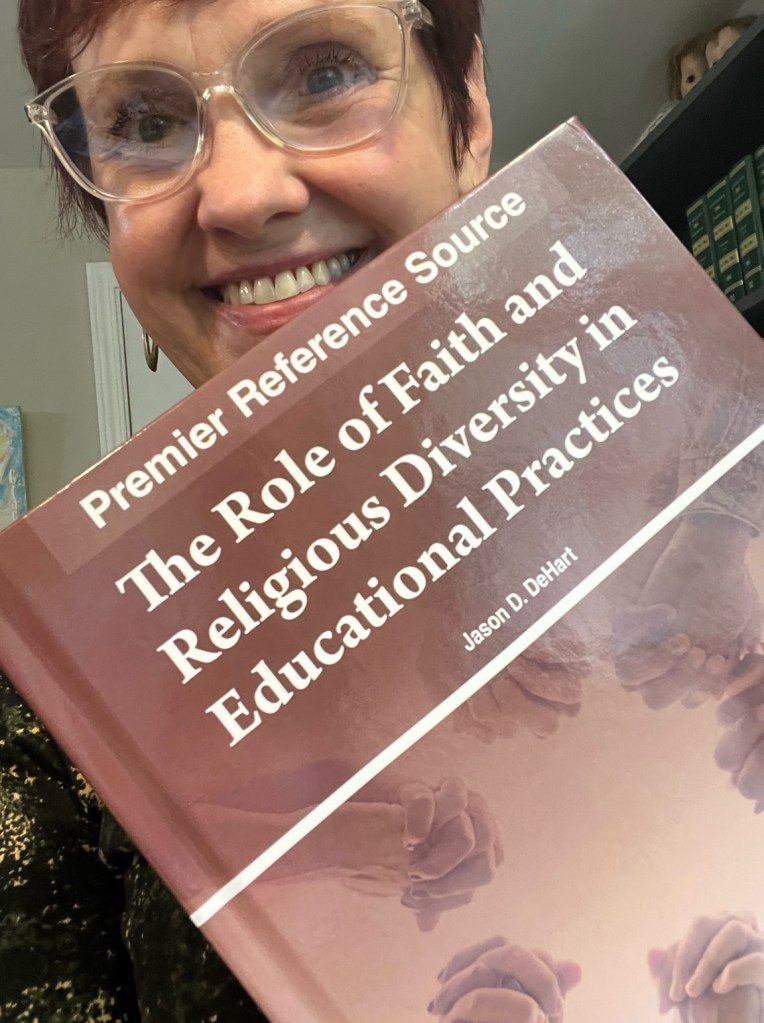

This was fun to write with my good friend, Kelly Fruchey. It is my first publication as a member of the National Coalition of Independent Scholars. The book and each chapter individually is available at IGI Global.
Proposal
Much of the proposal did not make the final cut, so I am posting it here:
The practice of diversity, equity, and inclusion by Christians who authentically strive to live out their faith is predicated on God’s creation of humanity as Imago Dei, made in the image of God. Humans, of all in creation, were literally breathed into life by the Spirit (רוּחַ/Ruach in Hebrew, πνεῦμα/Pneuma in Greek) and by that breath, all humans are to be honored, valued, and treated with dignity. In many ways, the failure of many who call themselves Christians led to a secular humanist approach to what should have been an essential part of Christian living.
DEI is based primarily on critical theory, which is foundationally linked to Marx’s theory. CT is both a False Dilemma fallacy and retributive in nature, categorically placing all people into oppressed and oppressor (victim and victimizer). By its very nature DEI seeks to forcibly bring all people up or down to the same level. ID on the other hand, strips all people of imposed categories to their basic fundamental level of equal human value. This, in a sense, levels the playing field by eliminating all human imposed categories or perceived historical or personal deeds. This identity requires no apologies or shame as it removes people entirely from human labels: all are inherently equal and valuable.
On the face of it, Diversity, Equity, and Inclusion (DEI) is a humanist parallel to the Christian conception of Imago Dei. But there is a striking difference between them: while the biblical principle is rooted in a belief that all of humanity is to be equally valued as the God-breathed pinnacle of creation, the other is grounded in a Freirean conviction of oppressors and oppressed in a constant battle for domination. Interestingly, Freire himself expected Christians to engage with his work (Freire, 1970, p.37) because he understood the basis of nonsectarianism expected by the Bible. He didn’t expect Christians to agree necessarily, but he anticipated they would participate in the dialog he suggested. His hope was that his concept of humanization might be a bridge between those he named “oppressors” and “oppressed;” fifty years later, his ideal of liberation is farther away than ever, with the right and the left warring against each other instead of seeking a common good.
DEI, while a noble ideal, has been politicized to the point that diversity, equity, and inclusion are for everyone except perceived oppressors, generally defined as white and/or Christian. Many people who align themselves ideologically with the DEI movement perceive these people of faith, both teachers and students, as oppositional to the general principles of DEI. Teachers are sometimes expected to become cultural warriors pursuing a form of social justice, with the intent to change and/or shame Christian students into making statements that contradict their belief systems. Many Christian teachers are required to act according to a secular humanist worldview both in and outside the classroom in spite of their personal religious beliefs to promote the continuity of the humanistic approach to social justice. Neutrality toward issues of faith by Christian teachers is virtually impossible (Hadley, 2021). Recent events in Arkansas, Arizona, and Virginia illustrate pressures felt by many Christian teachers around the country (Boroquez, 2023; Griffin, 2023; National Review [Eds], 2023, January 19; Saul, 2021). A pluralistic country like the U.S. thrives on open, honest, and democratic conversations, not a top-down dictate from well-meaning authorities. The teacher as culture warrior runs counter to the very ideals of teaching in practice, and the purpose of education.
Education’s purpose ideally enables students to “sift and weigh evidence, to discern the true from the false, the real from the unreal, and the facts from the fiction” (King Jr., 1947). Additionally, according to Dr. King, education pairs knowledge with moral character. More recently, a book by the late Sir Ken Robinson argued that education should enlarge students’ worldviews so they are able to engage in the world as individuals (Robinson and Robinson, 2022). The current trend of DEI may be seen as an anti-whiteness either/or rather than a path of both/and toward justice and unity (Boroquez, 2023; Romo, 2016). Teachers as DEI warriors create an ‘us vs them’ classroom and in the larger school culture.
Christian teachers are often held up as enemies of the DEI movement. Some Christian teachers have either resigned or have been forced out of their positions, leaving students of faith to be taught through a very myopic lens. If educational leadership presupposes that Christians are anti-diversity and anti-equity, then they assume that anyone holding this religious belief will do harm to the students. Presuppositions drive assumptions and assumptions drive action. This presupposition of harmful beliefs, then, limits civil discourse about difficult topics and can negate the ability of both teachers and students to grow and change by listening to and learning from others. In the town hall of ideas, every person must have a voice.
Diversity, equity, and inclusion are key functions of Christianity as defined in the Bible. Jesus’s disciples were both illiterate fishermen and highly educated, including a tax collector whose intellect was noticed by Rome. The larger group of disciples, outside the more familiar twelve, included both wealthy and poor, young and old, and even women, unheard of in the first-century Roman Empire. As far as equity is concerned, the Bible teaches that everyone is of equal value to God and that the Christian community is to be built on a foundation that eschews favoritism and embraces a community of unity: “There is neither Jew nor Greek, there is neither slave nor free, there is no male and female, for you are all one in Christ Jesus” (Galatians 3:28, ESV). Granted, Christians have neglected their calling to love their neighbors for most of the last 2,000 years, but the instruction for love, mercy, and living in peace with everyone is clearly written (Luke 10, Romans 12, James 2) and was practiced by the early Church (Acts 2:42-47).
God created human beings to be meaning-makers and we make meaning from the world around us; everyone has a “meaning” they want everyone else to understand. Are teachers, however, supposed to teach “their” meaning or teach students to be effective meaning-makers themselves? DEI often excludes people of faith and religious backgrounds from pursuing meaning-making according to their convictions. The presupposition of Imago Dei, on the other hand, is a true ideal of equity. There is no intersection, no faith-based diversity, nor diversity of thought if teachers are required to create a culture of a one-way street.
References
D. Abbot, A Bikfalvi, A.L. Bleske-Rechek, et al. (2023, April 28). In Defense of Merit in Science. Journal of Controversial Ideas. https://journalofcontroversialideas.org/article/3/1/236
Alexie, S. (2023, May 15). The “I” in BIPOC: Not all Native Americans are leftist political activists. [Substack] https://shermanalexie.substack.com/p/the-i-in-bipoc
Baker, N.D. (1999). Negotiating Christianity and Culture: Evangelical Teachers’ Perceptions of Race, Critical Knowledge, and Social Justice in Urban Christian Schools. [Dissertation]. UCLA. https://www.proquest.com/openview/2b31b568587fe44bf9f3e1884ddbe0b0/1?pq-origsite=gscholar&cbl=18750&diss=y
Attridge, H.W. (1998).The Diversity of Early Christianity. Frontline. https://www.pbs.org/wgbh/pages/frontline/shows/religion/first/diversity.html
Bhandari, S. (2022) The History of South Asians in the United States. South Asians in the United States: A guide for social workers and other helping professionals. NASW Press
Berkshire, Jennifer C. (2021, June 22). Culture war in the classroom. The Nation. https://www.thenation.com/article/society/culture-war-classroom-teachers/
Bojorquez, T. (2023, March 24). Arkansas school district blasted over teachers filling out white privilege survey. KZRG. https://newstalkkzrg.com/2023/03/24/arkansas-school-district-blasted-over-teachers-filling-out-white-privilege-survey/.
Cevallos, Tatiana M. (2019, January). Integrating faith and learning: Preparing teacher candidates to serve culturally and linguistically diverse students. International Christian Community of Teacher Educators Journal 14(1). pp 1-6
Cortman, D.A. (2023, May 4). ADF lawsuit prompts school district to renew agreement with Arizona Christian University. ADF Media. https://adfmedia.org/case/arizona-christian-university-v-washington-elementary-school-district
Communities in Schools [website] https://www.communitiesinschools.org/about-us/diversity-equity-and-inclusion/
The Editors (2023, January 19). The Virginia schools scandal. National Review. https://www.nationalreview.com/2023/01/the-virginia-schools-scandal/
Freire, P. (2000). Pedagogy of the Oppressed, 30th anniversary edition. M.B. Ramos [translator]. Continuum. original work published, 1970.
Griffin, A. (2023, March 10) Christian university sues Arizona school district for religious discrimination: Report. New York Post. https://nypost.com/2023/03/10/arizona-christian-university-sue-school-district-for-discrimination/
Hadley, H.L. (2021). Navigating Moments of Hesitation:Portraits of Evangelical English Language Arts Teachers. Myers Education Press.
Kaput, K. (2019, June 13). Nine recommendations for strengthening Minnesota’s Teacher Standards of Effective Practice. Education Evolving https://www.educationevolving.org/blog/2019/06/nine-recommendations-for-strengthening-minnesota-s-teacher-standards-of-effective
Kohlbecker, N. (2022, February 28). Navigating DEI in schools: Five crucial considerations. https://www.ascd.org/blogs/navigating-dei-in-schools-five-crucial-considerations
Kulkarni, S.S. (2021, April 4). South Asians are Asians, too. When will our racial reckoning be? Ms.Magazine. https://msmagazine.com/2021/04/24/south-asian-racism-fedex-indianapolis-sikh-shooting/
King, M.L. Dr. (1947). The purpose of education. The Maroon Tiger [student publication of Morehouse College). https://kinginstitute.stanford.edu/king-papers/documents/purpose-education
Marshall, Joanne M. (2003). Religion and education: Walking the line in public schools. Phi Delta Kappan 85(3). 239-242
McBrayer, J. P. (2022, May 22). Diversity Statements are the New Faith Statements. Inside Higher Ed. https://www.insidehighered.com/views/2022/05/23/diversity-statements-are-new-faith-statements-opinion
Minnesota Professional Educator Licencing and Standards Board (2023)Statement of Need and Reasonableness (SONAR).
National Science Teaching Association (2023) National conference. https://my.nsta.org/conferences/sessions.aspx?id=2023ATL
Nord, W.A. & Haynes, C.C. (1998). Taking religion seriously across the curriculum. ACSD. Retrieved from https://archive.org/details/takingreligionse0000nord
Perkins, J.M. (2018). One Blood: Parting Words to the Church on Race and Love. Moody Publishers
Robinson, K. and Robinson, K. (2022). Imagine if: Creating a future for us all. Penguin Books.
Rodriguez, A.J. (2001). Courage and the researcher’s gaze: (Re)Defining our roles as cultural warriors for social change. Journal of Science Teacher Education 12(3). 277-294. https://www.jstor.org/stable/43156279
Romo, V. (2016). How to change white teachers’ lenses. Slate. https://slate.com/human-interest/2016/06/how-white-teachers-can-become-culturally-competent.html
Saul, S. (2021, November 14). How a school district got caught in Virginia’s political maelstrom. The New York Times.
Schwerha, A. (23, February 28). Half of Professors Believe Diversity Statements Violate Academic Freedom, Survey Finds. The Lion. https://readlion.com 2/28/23
Shenvi, N. (2021). DEI done right: Disentangling Christian community from Critical Theory. Neil Shenvi- Apologetics. https://shenviapologetics.com/dei-done-right-disentangling-christian-community-from-critical-theory/
Sonessa, W.L. (2021, Winter). Imago Dei and the Tensions of Ethnic Identity. Journal of Ecumenical Studies. 56 (1). 116-147. https://muse.jhu.edu/article/787972
Stronks, J. K. (1999). Christian Teachers in Public Schools: A Guide for Teachers, Administrators, and Parents. Baker Books.
Szczerba, W. (2020) The Concept of Imago Dei as a Symbol of Religious Inclusion and Human Dignity. Forum Philosophicum: International Journal for Philosophy 25(1). 13-36. https://www.researchgate.net/publication/346910973_The_Concept_of_Imago_Dei_as_a_Symbol_of_Religious_Inclusion_and_Human_Dignity
Washington Elementary School District Board Meeting (2003, February) [YouTube] https://www.youtube.com/watch?v=oUaLqZblEFo&ab_channel=WashingtonElementarySchoolDistrict
Yoder, B. (2014). World Christianity: Diversity within a shared tradition. Boston University, School of Theology, Center for Global Christianity and Mission. https://www.bu.edu/cgcm/annual-theme/world-christianity-diversity-within-a-shared-tradition/comment-page-1/?unapproved=2664&moderation-hash=41609d5f17f03f7e45bf694a21c88d8b#comment-2664
YuKong Zhao, Stereotyping Asian-Americans: Harvard Calls It ‘Diversity’ But It’s More Like Racial Balancing, Forbes, 7/2015 https://www.forbes.com/sites/realspin/2015/07/09/stereotyping-asian-americans-what-harvard-calls-diversity-is-racial-balancing/?sh=3d12ddc65551


 Defaulting to Grace